
You design a thick, lipid-rich barrier cream. You add your soothing active. The lab sample feels like velvet. A month later, the client tests the prototype. They feel tiny, hard grains on their skin. The batch is rejected.
Formulators usually blame the waxes. They adjust the homogenization speed. They tweak the cooling curve.
The actual problem? Your soothing active crystallized.
Finding honest Stearyl Glycyrrhetinate suppliers is a headache. You buy what looks like fine Stearyl Glycyrrhetinate powder. You melt it into your oil phase. But low-grade extracts carry trace botanical impurities. Those impurities survive the melting process. During the cool-down phase, they act as seed crystals. They force the lipid matrix to break. Your smooth emulsion turns into a physical scrub.
You cannot fix bad raw materials with better emulsifiers.
True Stearyl Glycyrrhetinate is highly lipophilic. It is a modified licorice molecule engineered exclusively for the oil phase. Most cosmetic traders do not understand the chemistry behind it. They buy crude bulk powder. They cut it with fillers. They warehouse it in fluctuating temperatures.
We manufacture this directly. We strip the molecule down to its core. We eliminate the crystallization triggers. We control the purification. No middlemen.
Here is the exact data for your batch records.
| Parameter | Specification |
| INCI Name | Stearyl Glycyrrhetinate |
| Botanical Origin | Glycyrrhiza glabra L. (Licorice) |
| CAS Number | 13832-70-7 |
| Appearance | White to off-white crystalline powder |
| Assay | ≥ 95% (HPLC) |
| Solubility | Soluble in cosmetic oils, ethanol; Insoluble in water |
| Melting Point | 72°C – 77°C |
| Recommended Dosage | 0.1% – 0.5% |
Let’s talk bench chemistry. How do you actually formulate with this on Monday morning?
Do not treat this like Dipotassium Glycyrrhizate. It hates water. If you drop this into your aqueous phase, it will just float there like sand.
Put it directly into your oil phase. It demands heat. Bring your carrier oils up to 75°C or 80°C. Stir until the powder melts completely into a transparent liquid. Look closely at your beaker. If the oil phase is cloudy, the powder is not fully melted. Do not start emulsifying until that liquid is perfectly clear.
Watch your oil polarity. This molecule prefers medium to high polarity lipids. Caprylic/Capric Triglyceride is your best friend here. Squalane works, but it requires more time and heat to dissolve. If you rely entirely on heavy silicones or pure mineral oil, you will struggle to get a clear melt.
Why go through this high-heat lipid process?
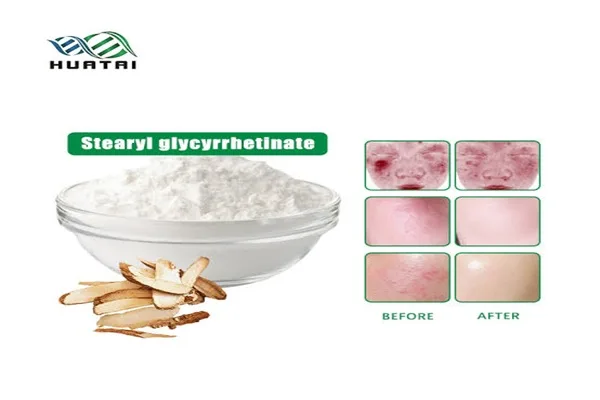
Because water-soluble soothing agents wash away. They sit on the surface of the stratum corneum. Stearyl Glycyrrhetinate is different. It perfectly matches the lipid profile of the human skin barrier. It sinks deep into the tissue. It locks in. This shuts down inflammatory triggers at the cellular level.
It is the ultimate tool for chemical peel aftercare. It handles severe retinoid reactions. It repairs compromised barriers.
Think about your SPF formulations. Chemical UV filters naturally irritate the skin. Formulators constantly fight the redness caused by the sunscreen itself. Stearyl Glycyrrhetinate solves this. It dissolves directly into the UV filter lipid phase. It calms the skin while the UV filters absorb the radiation.
Can you use it in anhydrous formulas? Absolutely. It is the perfect soothing engine for lip balms, body butters, and pure oil serums.
But you need absolute purity. You need a melting point that behaves predictably in your mixing tanks.
A cheap powder crashes your stability. A pure powder locks into your oil matrix and stays invisible.
We run the extraction and modification in our own facility. Check glabridin.net. We verify the melting point, the heavy metals, and the exact HPLC assay for every single drum before it ships.
Does your current supplier actually run an extraction plant? Ask them for their raw batch data.
Stop fighting crystallization on the bench. Start with a clean baseline. Heat it properly. Emulsify it clean. Your barrier creams will remain velvet.